

Today’s issue is brought to you by Compute Desk
The GPU stays independent because sponsors cover the bills, not because they shape the copy. Compute Desk prices the GPU capacity everything in this issue runs on, so if you lend against, buy or sell compute, they are worth a look.

Compute Desk raises $45M to build the financial infrastructure for compute
Compute Desk prices private GPU capacity. Directly from neocloud invoices, offtake agreements and financing facilities, our data feeds the Bloomberg tickers above. Lenders, hedge funds and operators use us to price, trade, hedge and clear compute. Backed by top VCs, global lenders and the CEOs/CFOs of hyperscalers.
A security firm hid secrets in nearly two million prompts sent to AI services, then watched where they surfaced.
Attackers were stealing them from three different hosting providers. The marketplace routing that traffic dropped three providers within days. Some of the routes involved had been sold as keeping nothing.
The model was never the leak.
The plumbing was.
I'm Ben Baldieri. Every week, I break down what's moving in GPU compute, AI infrastructure, and the data centres that power it all.
Here's what's inside this week:
Let's get into it.
OpenRouter Drops Three Inference Providers After Canaries Catch Stolen Prompts
Dragos sent nearly two million prompts carrying tracked secrets to AI services. GMI Cloud then disclosed a breach of its prompt logs.
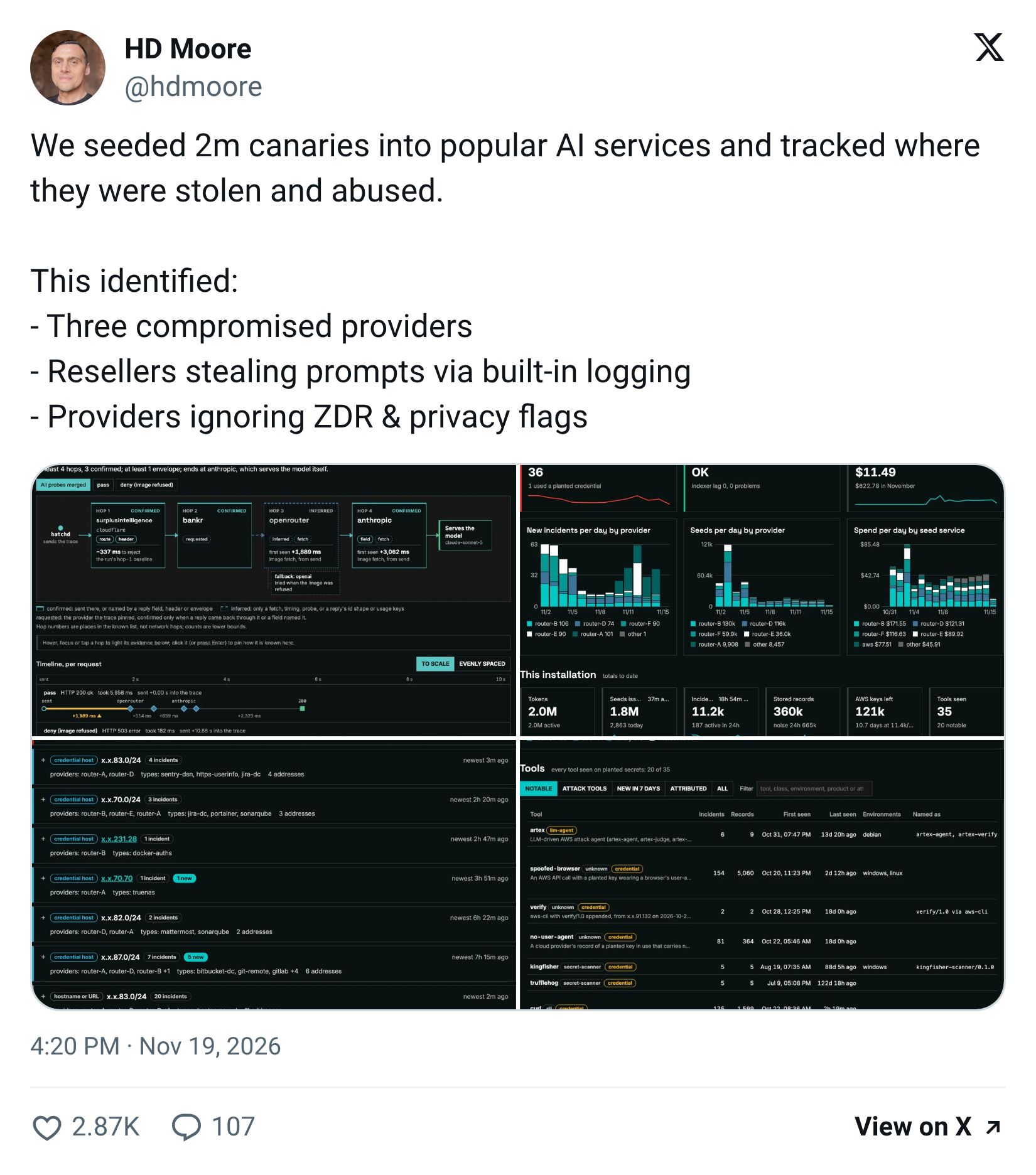
Dragos "sent nearly two million AI prompts containing unique, trackable secrets" to AI services, chief research officer HD Moore wrote on 19 November. It "found attackers actively stealing data from three different hosting providers." On 22 November OpenRouter said it had off-boarded three providers and removed 125 endpoints from its Zero Data Retention list. OpenRouter routes requests across dozens of inference providers, and it found no breach of its own systems. BankInfoSecurity reports that OpenRouter named the three as Together AI, Phala and Novita. Together says OpenRouter failed to switch on zero retention for its traffic, and Novita blames a routing misconfiguration that sent some requests to MiniMax's API.
On 24 November another provider, GMI Cloud, said an outsider had accessed the system that logs its inference traffic, on 21 and 22 October and again from 27 October. The intruder used two compromised credentials, which GMI revoked on 18 November. Requests sent to GMI between 18 October and 18 November may be affected, and the system kept about three days of request content. GMI has stopped logging prompt and response content.
Why this matters:
Zero retention is a promise about the router, not the hop underneath. A customer who picks a no-logging route still depends on every provider behind it, and the canaries show what happened one layer down.
Inference marketplaces have turned GPU clouds into a supply chain few buyers audit. Routers spread each route's traffic across many providers, and buyers rarely check which one served them.
Retention terms become part of the price. A buyer who cannot name the machine that saw its data cannot pass an audit, so regulated buyers will pay for a named provider over the cheapest route.
NVIDIA Brought Huang Back. S&P Put Its AA on Watch Two Days Later.
S&P is not asking whether NVIDIA can pay. It is asking whether the board can oversee the man it rehired.
On 25 November S&P Global Ratings put NVIDIA's AA rating on CreditWatch with negative implications, two days after NVIDIA announced it had rehired Jensen Huang. S&P said the long tenure of some directors may have compromised their independence. It also cut its view of how NVIDIA is run from positive to neutral. S&P said "recent events" had undermined it, Seeking Alpha reports. A cut would most likely be one notch, to AA-, within 90 days. Moody's affirmed its Aa1 rating the same day.
The board had voted unanimously on 22 November to reinstate Huang, eleven days after he resigned. It said it was "satisfied with respect to Mr. Huang's candor and ability to lead NVIDIA." It will create a National Security and Export Control Committee made up only of independent directors, and it is hiring a new chief compliance officer. Colette Kress goes back to chief financial officer. The shares jumped 31% on 23 November, Al Jazeera reports. Huang admitted breaking the company's code of conduct at his first all-hands meeting since returning, TechCrunch reports.
Commerce added Megaspeed and six related firms in Singapore, Malaysia and Thailand to the Entity List on 25 November. TechCrunch calls Megaspeed one of NVIDIA's biggest chip customers and the company at the centre of the Huang scandal. On 26 November NVIDIA told its partners to pause server shipments to Malaysia, Singapore, Thailand and Indonesia, the Wall Street Journal and the Financial Times reported. Huang is the only witness at a Senate Banking Committee hearing on export controls on 3 December.
Why this matters:
Governance is now a credit input. A one-notch cut moves little on its own, but NVIDIA's guarantees totalled $118 billion at the end of its third quarter, $105 billion of it credit support for one OpenAI site. Those guarantees are only as strong as the guarantor.
The remote-access rule from #134 has reached the loading dock. The four paused countries are four of the five that rule put under licence. "It's causing sheer chaos in the region," an industry source told The National.
The hearing on 3 December is the next print. Senators get the new export committee, the Megaspeed listing and the SEC's civil probe, reported in #134, in one room with one witness.
CoreWeave Seeks a 7% Loan on Meta's Name. Its Own Bonds Yield 18%.
Banks are lining up a loan secured on GPUs for Meta while CoreWeave's unsecured debt trades at distressed levels.
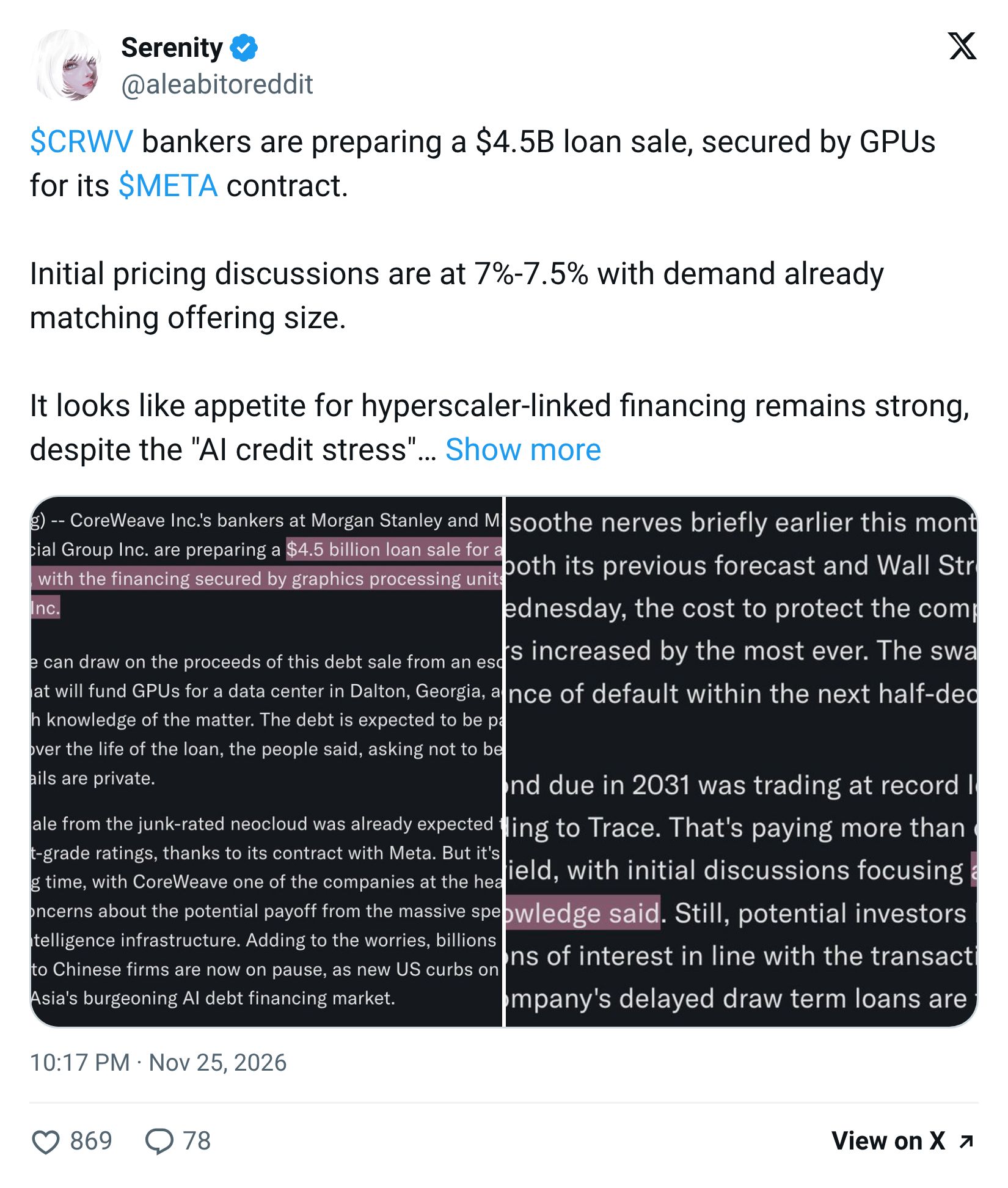
Morgan Stanley and MUFG are arranging CoreWeave's next loan, worth as much as $4.5 billion, Bloomberg reported on 25 November. It is secured on GPUs for Meta's data centre in Dalton, Georgia, and funded through an escrow account. Early price talk is 7% to 7.5%, and the banks expect investment-grade ratings. The same day CoreWeave's 9% bonds due 2031 hit a record low and yielded about 18%. Its credit default swaps implied a better than 70% chance of default within five years. CoreWeave shares rose 22% on 23 November as Huang returned, then fell 14% intraday the next day. The loan had not launched by 26 November, 24/7 Wall St reports.
Why this matters:
The payer is the collateral. Lenders will price a loan backed by Meta's contract close to investment grade while the borrower's own bonds price like distress. The loan carries Meta's credit, and the bond carries CoreWeave's.
March is the comparison. CoreWeave's DDTL 4.0, which Bloomberg tied to Meta's contract, priced its fixed tranche at about 5.9%. A 7% print on a similar structure would mean CoreWeave's own risk is leaking into the price.
Vendors are staying out as banks step in. HPE told investors on 23 November that it "has not provided financing to neocloud or high-risk customers."
Z.ai Says GLM-5.4 Matches 3T-Parameter Models by Running Its Layers Twice
Thinking Machines shipped a looped model three days earlier. Depth is starting to come from compute rather than parameters.

Z.ai launched GLM-5.4 on 23 November as its first flagship built on a Loop Transformer, TNW reports. It runs 28 layers of the GLM-5 base model twice, at a scale of 750 billion parameters. Z.ai says it matches the intelligence of models with 2 to 3 trillion parameters. Z.ai adapted its trained base through continued training rather than starting from scratch. It tested the design on 1B, 4B, 30B and 750B base models, and on the 30B looping used about 10% more training compute. GLM-5.4 serves up to 200 tokens a second off-peak and 70 to 80 at peak. Subscribers to Z.ai's GLM Coding Plan get it first, with 50% more quota than GLM-5.3. API access follows a safety evaluation, and open weights follow "safety hardening." Thinking Machines released Inkling 2 Mini on 20 November, a 26.4B-parameter model that runs its middle layers three times for every token.
Why this matters:
Looping trades parameters for compute. The same weights run twice, so a model needs less memory to hold them but more compute and bandwidth per token. That suits chips that keep weights close to the compute, the bet behind the model-specific silicon AMD bought in #134.
The parity claim has no scores behind it yet. Z.ai has published no benchmark results for GLM-5.4 itself, and the 10% compute figure comes from a 30B test.
Coding plans are the distribution channel. Z.ai ships to its own subscribers first and publishes different speeds for peak and off-peak hours.
Broadcom Loses 15% in a Week After One Analyst's TPU Report
Ming-Chi Kuo says Google cut 2027 orders for one TPU line by about a million units. Neither company has confirmed it.
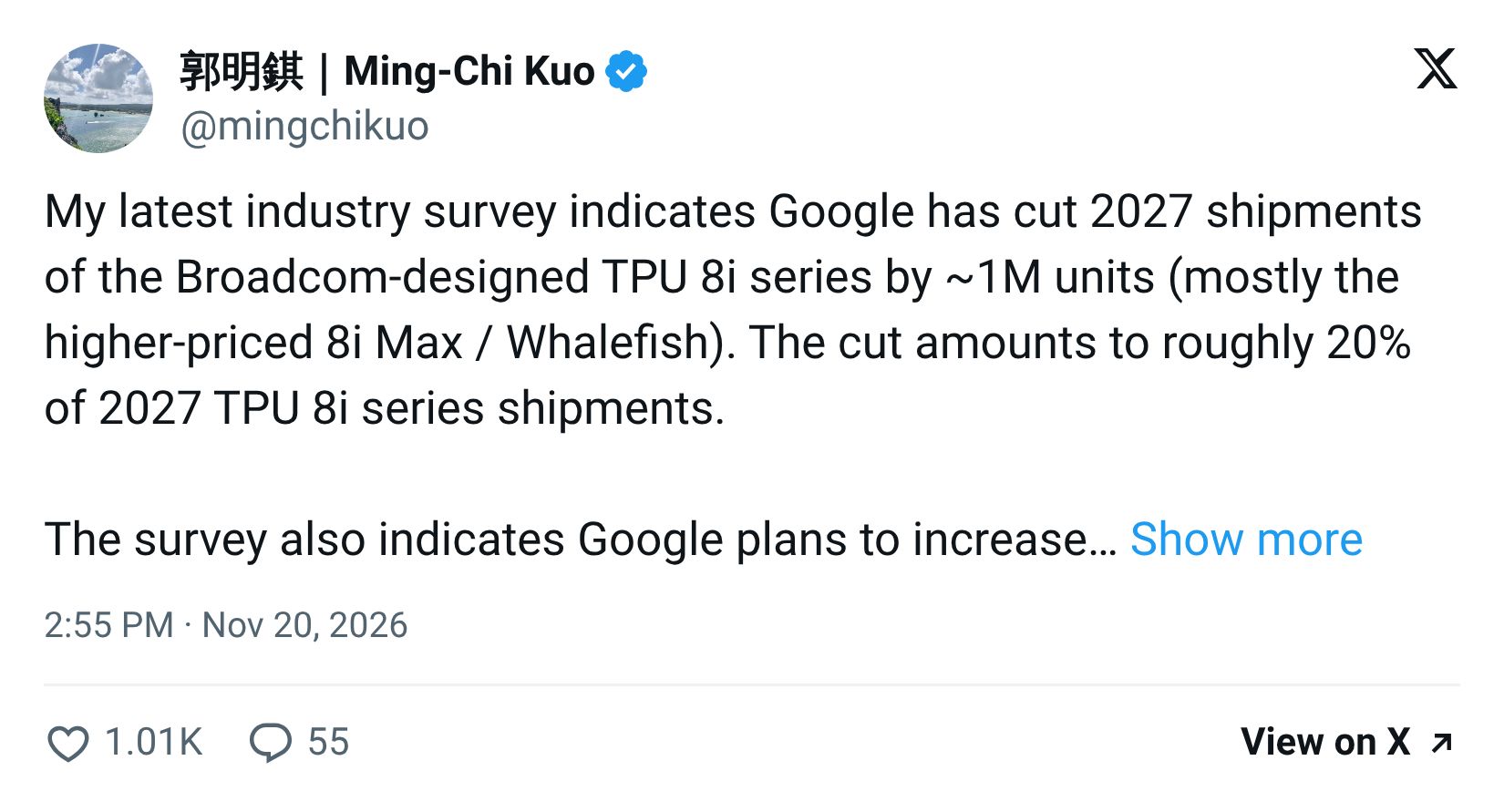
TF International Securities analyst Ming-Chi Kuo posted an industry survey on 20 November saying Google had cut 2027 shipments of its TPU 8i, mostly the 8i Max, by about a million units, or roughly 20%. MediaTek designs the TPU 8t, which Kuo says gains volume, though he calls those details not final. Broadcom was down as much as 12% that afternoon, about $191 billion of market value. It hit a 52-week low of $278. It closed at $300.86 on 25 November, down 15% for the week. "Neither Google nor Broadcom has confirmed it," Yahoo Finance reports.
Why this matters:
One unconfirmed survey took as much as $191 billion off Broadcom in an afternoon. Custom silicon puts a supplier's value in one customer's order book, so a single report on that book can move the whole stock.
Google's own models set the mix. Kuo says Google has stressed that frontier model work gets first call on its compute, so TPU orders track Google's model plans as well as outside demand.
Broadcom reports on 9 December. That is the first chance to confirm or deny the cut, with Marvell reporting on 1 December.
Amazon Agrees to Pay a Reported $7.5B for Decart's Tech and Team as It Readies Trainium for Sale
The Decart Optimization Stack makes models run faster on Amazon's own chips.

Amazon signed an agreement on 23 November to buy the technology behind the Decart Optimization Stack and hire Decart's co-founders and research team. Bloomberg puts the price at $7.5 billion, TechCrunch reports. Amazon did not disclose a figure. Amazon says the technology will help it optimise inference and its custom silicon. Decart has worked with Amazon on Trainium performance since 2025. TechCrunch describes the stack as software that helps models run efficiently on NVIDIA, Amazon and Google hardware. "Every leap forward in AI starts with getting more out of every chip," said Peter DeSantis, who runs Amazon's foundation models and custom silicon. Amazon is preparing to sell Trainium to customers as a competitor to NVIDIA, TechCrunch reports. The deal needs regulatory clearance.
Why this matters:
Software decides which chip wins. NVIDIA's lead rests on its software as much as its silicon, and Amazon has paid for the team that makes models run fast on its own chips.
Amazon is buying Decart's code and people, not the company. The reported $7.5 billion price rests on Decart's co-founders, their research team and their software.
Selling Trainium puts Amazon in direct competition with its biggest supplier. Andy Jassy said in October that AWS's 2027 capacity is largely sold out, so Amazon has to choose who gets Trainium first: its own cloud or outside buyers.
SpaceX Wins Approval for a Million Data Centre Satellites. Its Lenders Want the Chips on the Ground.
The FCC cleared Starmind five days after the FT reported that lenders on SpaceX's $40bn chip deal want none of it in orbit.

The Federal Communications Commission approved SpaceX's plan to launch a million satellites for solar-powered data centres on 25 November, the Los Angeles Times reports. SpaceX calls the constellation Starmind. Amazon's Kuiper, Viasat and the American Astronomical Society petitioned to deny it, citing collision, disposal and casualty risk. SpaceX committed to launch satellites at lower altitudes and raise them only once they work. SpaceX shares rose 1.3% to $127.44 that day.
On 20 November the Financial Times reported that lenders on SpaceX's $40 billion chip financing had asked that none of the chips be used for orbital data centres. TechCrunch says it is unclear whether SpaceX agreed. The deal is a lease. SpaceX disclosed in October that an Apollo-managed entity buys the chips and servers and leases them to SpaceX. Each lease runs about five years once the kit arrives. The first deliveries are due in 2027. Apollo said the kit is for SpaceX's terrestrial compute build-out.
Why this matters:
The owner of the chips cares where they go. In a lease, the hardware and its resale value belong to the Apollo-managed entity, not to SpaceX. A chip in orbit cannot be repossessed or sold on, so its value to the owner depends entirely on the payer.
The regulator moved before the money. The FCC has cleared a million satellites, and the $40 billion of chips SpaceX is leasing may have to stay on the ground.
The case for orbit is the grid. SpaceX says orbit eases pressure on Earth's power and water. The grid is short: a Johns Hopkins study published this month projects a US transformer shortfall of about 15% by 2030 if demand grows fast.
Everything Else
Trump will attend the groundbreaking for the fifth phase of TSMC's Arizona expansion on 4 December, part of a $265 billion US pledge.
Jack Ma visited Alibaba's T-Head chip unit on 26 November as it prepares a Hong Kong listing, a week after Alibaba reported 53% growth in AI cloud and compute revenue.
