

Today’s issue is brought to you by Compute Desk
The GPU stays independent because sponsors cover the bills, not because they shape the copy. Compute Desk prices the GPU capacity everything in this issue runs on, so if you lend against, buy or sell compute, they are worth a look.

Compute Desk raises $45M to build the financial infrastructure for compute
Compute Desk prices private GPU capacity. Directly from neocloud invoices, offtake agreements and financing facilities, our data feeds the Bloomberg tickers above. Lenders, hedge funds and operators use us to price, trade, hedge and clear compute. Backed by top VCs, global lenders and the CEOs/CFOs of hyperscalers
Control moved this week.
A lab that has promised its suppliers nine hundred billion dollars sold a slice of itself to them. The chipmaker that funds its own customers said its guarantees start only once the building is ready. A security company paid four and a half billion dollars so its customers can own their models. A rival chipmaker bought chips that can run only one model. The biggest software company in the world started licensing weights.
Washington reached past the chip to whoever uses it.
Control used to come with the hardware.
Now it comes with the paperwork.
I'm Ben Baldieri. Every week, I break down what's moving in GPU compute, AI infrastructure, and the data centres that power it all.
Here's what's inside this week:
Let's get into it.
Washington Now Has a Say in Who Uses Your Compute
The remote-access rule reaches past who buys the chips to who consumes them, and model-level control is the next step.

Since 2022, US export controls have governed who can buy advanced chips. The Bureau of Industry and Security's interim final rule, issued on 16 November and published in the Federal Register on 19 November, governs who can use them. Treasury, under Scott Bessent, and the National Security Council, run by Marco Rubio, wrote it. Politico read that as a signal it bypassed Commerce Secretary Howard Lutnick. Data centres still choose their own tenants. Serving some of those tenants now needs Washington's sign-off. Any data centre, anywhere, running advanced US chips above 12 million units of aggregate TPP needs a licence to serve companies headquartered in China, Macau or other D:5 countries, to give one more than half its compute as a remote user, or to train models for one. Existing arrangements have 90 days to get licensed. Chip suppliers must obtain "sufficient information about the foreign data center's 'know your customer' process", and a refusal counts as a red flag, Pillsbury's summary says. Shipments to Indonesia, Malaysia, Singapore, Thailand and Brazil need licences too, unless the end user is headquartered in the US and files monthly reports. The rule already looks at what some customers run. A carve-out for recommendation systems applies only if the operator confirms exclusive use and reports the customer to BIS. Control at the level of a single model has a precedent too. In June a Commerce letter barred any foreign national from Anthropic's Mythos 5 and Fable 5, including its own non-US staff, and Anthropic switched both models off for every user. Two weeks later Commerce let it restore Mythos for more than 100 US organisations that run critical infrastructure.
Why this matters:
Control has moved up the stack. Washington first decided who could buy the hardware. Now it has a say in which customers consume the compute, and US-headquartered firms in the five listed countries get the easier path by reporting. That path may narrow. Trump said on 20 November that American companies building data centres abroad would face a "tremendous tax", Reuters reports, which would hit Equinix and Digital Realty. "For Malaysia, the controls could be disastrous," Joshua Kurlantzick of the Council on Foreign Relations told Fortune.
Approved models are the logical next layer. BIS already treats recommendation systems differently from other workloads. The Mythos letter decided who could use one specific US model. Put the two together and you reach a licence that names which models may run on US chips, and for whom. This rule does not go that far. The first licence conditions will show how close it gets.
Owning the chips no longer settles sovereignty. A national data centre can buy its hardware outright and still need Washington's permission over who uses it. If the Mythos approach spreads, it may need permission over what runs on it too. The sovereign AI questions we have tracked since #93 and #95 now reach the customer list.
Anthropic Goes Public With Its Suppliers Holding Nearly 30%
Amazon and Google take large non-voting stakes, and six more suppliers buy in alongside the listing.

Anthropic priced its IPO at $83 a share on 18 November, above its $70 to $78 range. It sold 980 million shares, including about 24 million from its co-founders, for $81.3 billion, the largest IPO on record, CNBC reports. Fortune puts the valuation at the IPO price at about $1.5 trillion. Orders reached nearly seven times the shares on offer. ANT opened on Nasdaq at $111.50 on 19 November. It closed at $97.17, 17% above the IPO price, Yahoo Finance reports. On its second day it fell as low as $83.05, five cents above the offer price, FinanceFeeds reports, as a global AI selloff deepened. A filing disclosed on 17 November shows Amazon will hold 14.7% of the company after the listing and Google 13.7%, TechCrunch reports. Alongside the offering, AMD, Broadcom, Google, Micron, Microsoft, NVIDIA and TSMC are buying $26 billion of non-voting stock at the IPO price, with Google and NVIDIA taking $10 billion each. Anthropic counted $900.9 billion of commitments in its second amended S-1 (#133).
Why this matters:
The suppliers own a large piece of the customer. Amazon and Google sell Anthropic much of its compute. Together they will hold about 28% of its equity, and six more suppliers are buying in through the placement. A vendor that is also a top shareholder has every reason to keep extending terms.
Amazon's unconverted notes are the swing factor. Converting the rest would lift it to 23.8%, TechCrunch reports, nearly a quarter of a company that buys its chips and cloud.
The influence sits in contracts, not votes. Amazon's shares convert to voting Class A only when sold, per the filing. The suppliers shape Anthropic through what it owes them rather than through the boardroom.
NVIDIA Will Keep Backing Neoclouds, but Only Once They're Built
Kress said the support continues, and the guarantee lapses if a project slips.
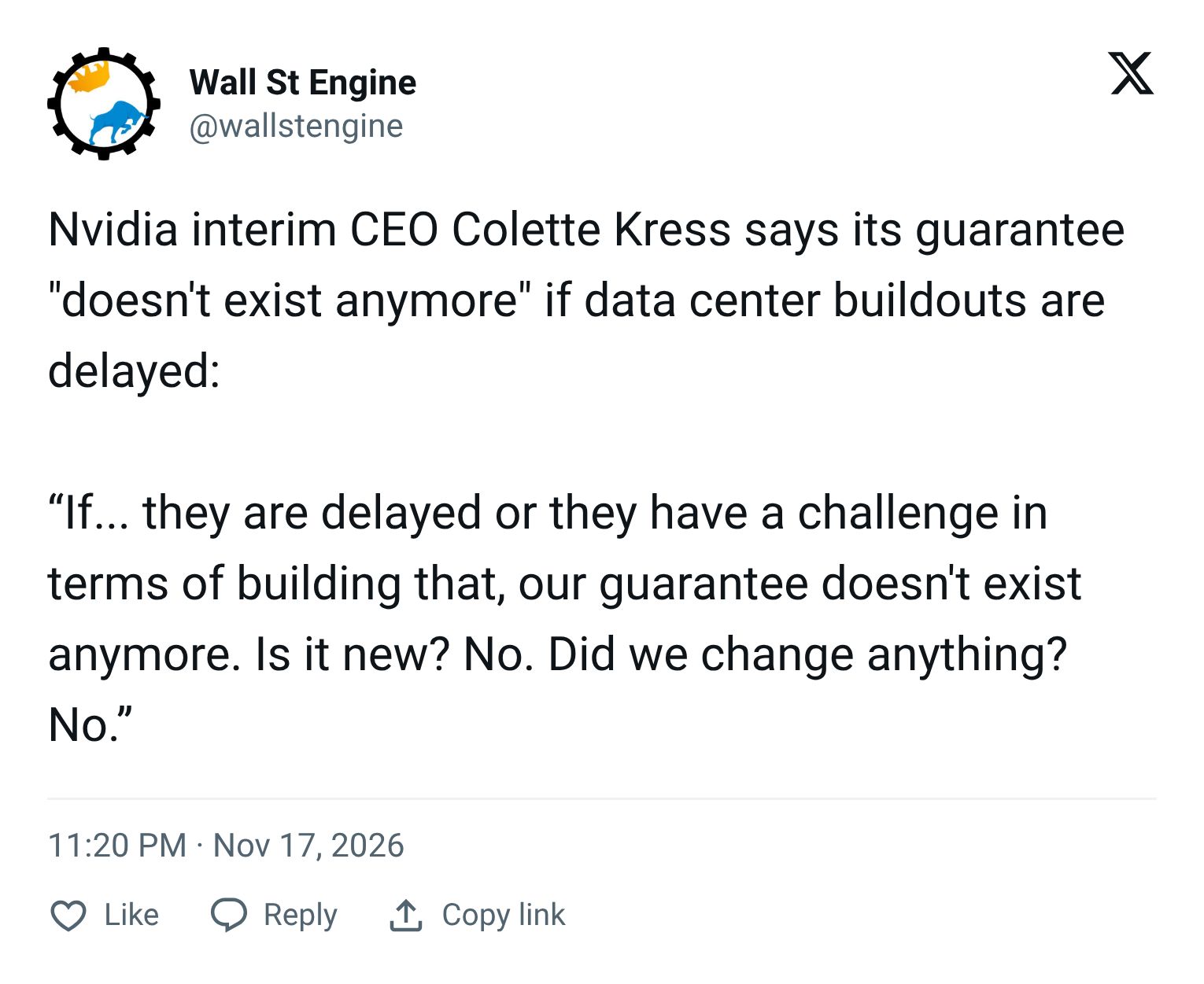
NVIDIA's first results since Huang's exit showed third-quarter revenue of $115.8 billion, up 103% year on year. On NVIDIA's call, Kress said commitments under its neocloud agreements "totaled $32 billion at the end of Q3" and total guarantees were $118 billion, $105 billion of it credit support for the PORTS-Pike campus that OpenAI will lease. NVIDIA "will continue to be disciplined and selective" in its support, she said. If a project is "delayed or they have a challenge in terms of building that, our guarantee doesn't exist anymore." CoreWeave rose 5.9% and Nebius 7.8% in premarket trading the next morning, Investing.com reports. Older GPUs are helping the borrowers. On CoreWeave's 10 November call, chief executive Mike Intrator said "pricing for Amperes and Hoppers increased 30% to 50% quarter-over-quarter", above their original contracts. Silicon Data's H100 index rose 2.4% on average over the same quarter. Nebius moved some capacity into the first half of 2027 and now expects 2026 revenue at the low end of its $3.0 to $3.4 billion range.
Why this matters:
The terms are not new. The disclosure is. NVIDIA's guarantee starts once a project is ready, which leaves construction risk with the neocloud and its lenders. "Is it new? No. Did we change anything? No," Kress said.
Old silicon is earning more than its contracts. More than 130,000 CoreWeave GPUs come off contract in 2027 and about 170,000 in 2028. If CoreWeave keeps renewing above the originals, ageing GPUs become collateral that gains value.
The posted market lags the negotiated one. Single-digit moves in public rental prices sit beside renewals agreed far higher, so the clusters that matter to lenders are priced in private contracts.
Palo Alto Pays $4.5B as Model Ownership Becomes the Next Frontier
Applied Compute and Prime Intellect sell enterprises the training loop that only frontier labs used to run.
Palo Alto Networks agreed on 18 November to buy Applied Compute, which post-trains and serves open-weight models on a company's own data. The all-stock deal is valued at $4.5 billion. Former OpenAI researchers founded Applied Compute in 2025. It raised $350 million at a $3.25 billion valuation on 3 November, after passing $100 million in annualised revenue. Microsoft and DoorDash are customers, SiliconANGLE reports. "Customers will still own and control their models," co-founder Yash Patil wrote. Palo Alto plans to sell "secure, sovereign versions of open-weight models" and expects the unit to reach $1 billion of annual recurring revenue by fiscal 2029. The same day, Prime Intellect launched Model Factory, which puts pre-training, fine-tuning, reinforcement learning and inference on one stack. It bills per GPU-hour or runs on dedicated clusters. "Frontier labs own the full loop, training and deploying intelligence, and capturing the data required to train the next model," Prime Intellect said. "We believe every company should have that same ability."
Why this matters:
The loop is the moat. Frontier labs improve their models on what their products see in production. Applied Compute and Prime Intellect sell that loop to any company with data, so the model becomes something the company owns rather than rents. Microsoft's version (below) keeps the weights on Azure.
Open weights are the raw material. Both platforms start from open-weight models. "Every enterprise is going to run a mix of open and closed models," Palo Alto chief executive Nikesh Arora said, and he puts the serving opportunity in "the hundreds of billions of dollars."
Owned models still need compute. Palo Alto plans more than 100 MW over three to five years, and Prime Intellect sells by the GPU-hour. Sovereign models will still run on US chips, under the rule above.
AMD Pays $2.9B for Chips That Run Only One Model
AMD closed its purchase of Taalas, whose chips carry a model's weights in the silicon itself.
AMD completed its acquisition of Taalas on 17 November, three months after agreeing the deal. AMD's quarterly filing values the purchase at about $2.9 billion, Techi reports. Ljubisa Bajic founded Taalas in Toronto in 2023. Its chips carry a model's weights etched into the silicon, instead of loading them from memory. Its first chip runs Meta's Llama 3.1 at about 17,000 tokens per second per user, the company says, though that version compresses the model and loses some output quality. The chip can then run only that model. Switching models means redoing two metal layers, which Taalas says cuts the turnaround from about six months to two. AMD plans to put the technology on its accelerator roadmap alongside its Instinct GPUs.
Why this matters:
One model per chip is the bargain. Taalas gives up flexibility to win on speed and cost per token. "You better really love that model," The Register wrote.
Nearly half the price is contingent. Up to about $1.4 billion depends on conditions AMD has not disclosed.
AMD now sells two kinds of inference chip, general-purpose GPUs and single-model silicon. "There's no one-size-fits-all as it comes to chips," chief executive Lisa Su said in July.
Microsoft Will License Its Models' Weights to Customers
MAI Licensed Weights lets an enterprise tune a Microsoft model and run it in its own Azure environment.

Microsoft announced MAI Licensed Weights at Ignite on 17 November. Customers take a frontier MAI model, "customize it using your proprietary data", and "run it securely in your own Azure environment", Microsoft AI said in its keynote. Access starts through Frontier Company engagements, and Microsoft gave no pricing or terms. Microsoft says its cheaper MAI Code 2 delivers 98% of GPT-6.1 Sol's performance on everyday enterprise coding and costs 5% of Claude Opus 5.5, and that MAI Cyber 2 Flash beats GPT-6 Astra on CyberGym at under 2% of the cost per task. Its Maia 300 chip "will deliver 40 percent more tokens per watt compared with leading GPU-based systems," the company said.
Why this matters:
Weights are now a product. Microsoft licenses them to customers who stay on Azure, so the model leaves Microsoft's API but not its cloud.
Microsoft is pricing against its partners. OpenAI and Anthropic both sell through Azure, and Microsoft's own models now undercut them on its own platform.
The chip claim needs a benchmark. Maia 300's efficiency is measured against unnamed "leading GPU-based systems", and Microsoft gave no availability date.
Orennia Says 191GW of Planned US Data Centres Faces New Risk After the Midterms
Texas, Ohio and Georgia elected Democratic governors who campaigned on pausing construction.

Energy analytics firm Orennia estimates about 191 GW of planned data centre capacity faces new risk after the midterm elections, Utility Dive reports, concentrated in Texas, Ohio and Georgia, where incoming Democratic governors campaigned on pausing or restricting construction. Texas accounts for nearly half of US pre-construction development. Governor Greg Abbott, who paused new data centre interconnections over the summer, lost to Gina Hinojosa. If 20% of projected Texas data centre demand fails to arrive, Orennia models ERCOT solar and wind wholesale revenue falling 38% and 37%.
Why this matters:
Announced capacity is not delivered capacity. AEP Ohio's large-load tariff made data centres pay for at least 85% of what they reserved. Its pipeline then shrank from more than 30 GW to about 13 GW.
Delays now cost twice. A neocloud project held up by a state moratorium could also lose NVIDIA's guarantee, on Kress's terms.
Utilities carry the stranded risk. Those that build for delayed projects could be left holding billions in infrastructure, Utility Dive reports. "Prolonged uncertainty will increase the cost of capital," said Andrejka Bernatova of Dynamix Capital Partners.
Everything Else
Alibaba released Qwen4-Max through its API only, with no downloadable weights, at $1.50 and $4.50 per million input and output tokens.
Digital Realty will spend $10 billion more on data centres in Japan over the next decade, its chief executive told Nikkei.
SoftBank posted a quarterly loss of about $7 billion, $3.7 billion of it from non-refundable gas turbine deposits for its PORTS campus in Ohio, the Financial Times reports.
Cerebras is readying CS-5 systems for 2027 and has won another hyperscaler, The Next Platform reports.
Akash Network published plans for Compute Forwards, monthly contracts for B300 GPU-hours, with a pilot targeted for early 2027.
The SEC has opened a civil probe into whether NVIDIA's disclosures misled investors, the Wall Street Journal reports.
A ransomware group called The Gentlemen listed NVIDIA on its leak site on 18 November with a countdown to 28 November and no data samples. NVIDIA has "found no indication that NVIDIA systems or networks were affected" and is investigating an incident that may have hit a third-party partner.
