

An AI lab made money from running its business for one quarter.
The next quarter, revenue rose by half. The compute bill rose by three quarters, and some of it was bought at a premium. Its commitments now come to almost nine hundred billion dollars. Its customers can buy a Chinese model three points behind it for half the price.
The profit was timing.
The commitments are not.
I'm Ben Baldieri. Every week, I break down what's moving in GPU compute, AI infrastructure, and the data centres that power it all.
Here's what's inside this week:
Let's get into it.
Anthropic's Profit Is Gone. Its $895bn Bill Isn't.
The amended S-1 adds the September quarter, and the first full count of what Anthropic has agreed to pay for compute.

Anthropic filed an amended S-1 on 2 November with results for the three months to September. It is the only frontier lab that reports by the quarter, so each filing is the clearest record of what a lab's compute costs against what it earns. Revenue reached $17.0 billion, up 47% on the June quarter. Compute and infrastructure cost $9.9 billion, up 77%, or 58% of revenue against 48% three months earlier. The filing puts the rise down to the delivery of additional compute. That includes $5.0 billion bought under short-term commitments. The filing says that compute costs significantly more than compute under its multi-year contracts. The $974 million operating profit of the June quarter became a $567 million operating loss. Other operating and administrative costs rose from $1.0 billion to $3.6 billion. The filing says most of the rise was a non-cash charge for its donation matching programme, and does not give the amount. The net loss was $23.3 billion. Anthropic left the total blank in its original S-1. The amendment puts it at $895.4 billion, almost all compute and infrastructure. Of that, $447.5 billion falls due before the end of 2030 and $69.8 billion in the next twelve months. Anthropic ended September with $95.6 billion in cash and $36.3 billion in short-term investments. It also has $14.8 billion of undrawn credit. About $213.8 billion of the commitments can be terminated, or depend on the other side securing financing, facilities or approvals first.
On 4 November Google agreed to stand behind one of Anthropic's leases. A TeraWulf filing shows Google will backstop Anthropic's 20-year lease of about 401MW at TeraWulf's campus in Hawesville, Kentucky. If Anthropic misses rent or becomes insolvent, Google can pay the rent and take over the lease. In some cases it can instead pay a termination fee and take equity in the campus company. The backstop ends once Anthropic holds an investment-grade credit rating for three months. Google is also one of Anthropic's biggest suppliers. The amended S-1 shows Anthropic has committed to spend at least $121.3 billion with Google between April 2026 and July 2033, whether it uses the capacity or not.
Why this matters:
Two quarters make the first trend line any frontier lab has published. The June profit and the September loss come from the same mechanism: compute ordered 12 to 18 months ahead lands on a fixed schedule, and revenue has to outrun it every quarter.
Google now stands behind both sides of Anthropic's build. In 2025 Google backstopped $3.2 billion of Fluidstack's leases at TeraWulf's Lake Mariner campus and took warrants for about 14% of TeraWulf (#57, #58). It backstopped another $1.4 billion of Fluidstack's lease at Cipher's Barber Lake site (#66). Fluidstack is building Anthropic's $50 billion US data centre programme (#74). In Kentucky, Anthropic signed with TeraWulf directly and Google backs the tenant. If Google guarantees both the operator and the offtaker, what risk is Fluidstack being paid to carry?
The price Anthropic competes with keeps falling. Moonshot cut Kimi's price by a third in October. Applied Compute sells companies custom models built on Qwen and Kimi, at less than half the inference cost of a frontier model in Harvey's case.
OpenAI Cut Its Funding Target by a Third
The round fell from $30bn to $20bn, at a lower valuation, and $11bn is committed so far.

OpenAI has cut the target for its new funding round to $20 billion, the Financial Times reports. In September it was reported to be raising $30 billion at a $1.4 trillion valuation. The new round values it at $1.25 trillion, TechCrunch reports. A group of investors from the United Arab Emirates will lead it, and a later offering to wealthy individuals could take it to the target, according to the FT. OpenAI has secured $11 billion so far, and some large investors gave the round a tepid response, The Wall Street Journal reports. OpenAI had not commented when TechCrunch published.
Why this matters:
Investors now have one frontier lab's quarterly numbers to price against. Anthropic's amended S-1 shows compute costs outrunning revenue in the September quarter, while OpenAI publishes no quarterly figures and is asking for less money at a lower price.
The money comes from the Gulf and from wealthy individuals. Anthropic's backers include the hyperscalers and chip vendors that sell it compute, while OpenAI's round leans on sovereign and private wealth.
Less equity leaves more of the compute bill to revenue and debt. OpenAI has signed multi-year compute contracts with Oracle, Microsoft, AMD and others, and the round that was meant to fund them is a third smaller.
Applied Compute Reached $100m of Run-Rate Revenue in Under 18 Months
The company builds custom models on open weights such as Qwen and Kimi for Harvey, DoorDash and Microsoft, and is raising to buy its own chips.
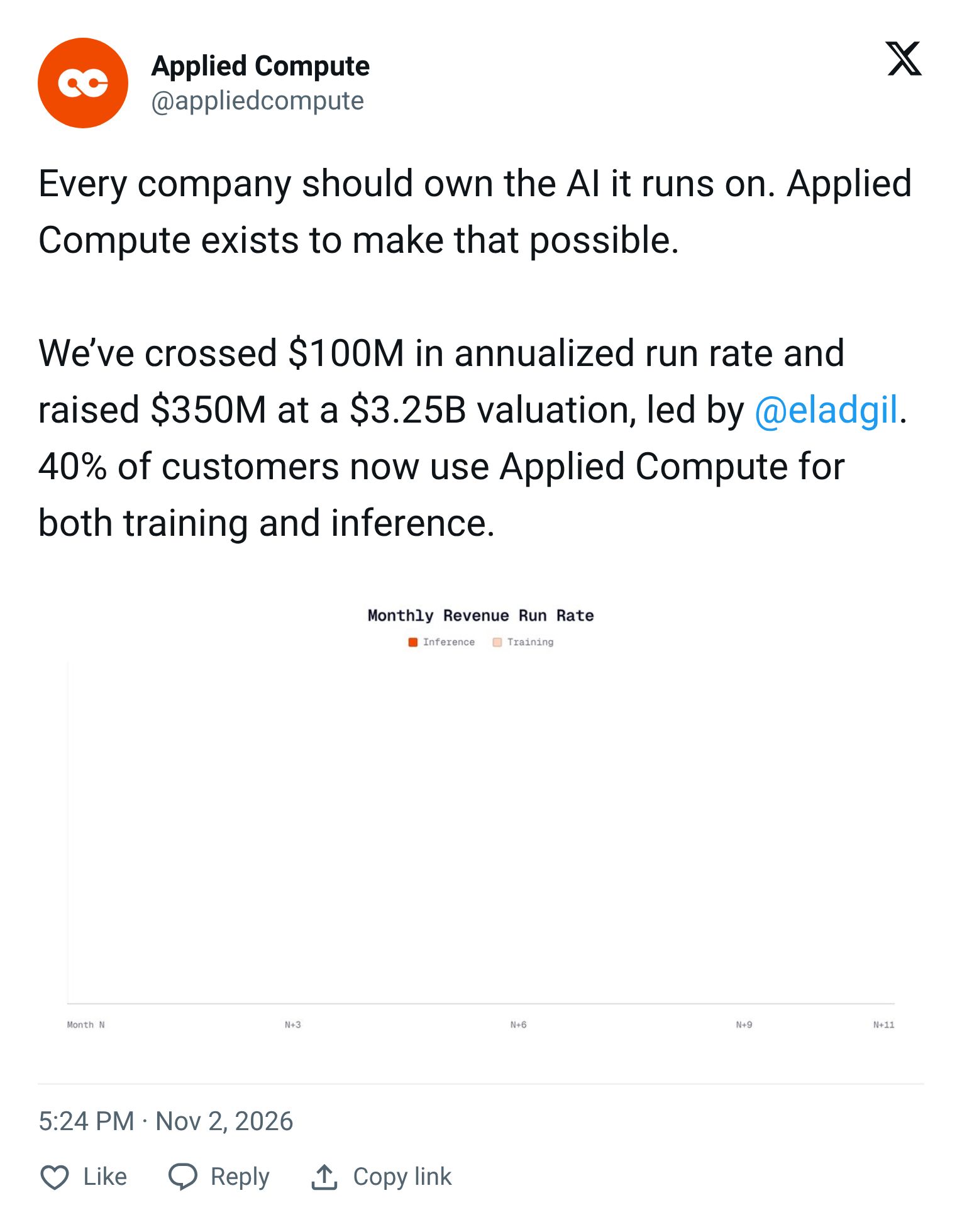
Applied Compute raised $350 million at a $3.25 billion valuation on 2 November. Elad Gil led the round, with Kleiner Perkins, Lux Capital, NVIDIA, Blackstone and Shopify Ventures among the investors. The company says it passed $100 million of annualised run-rate revenue less than 18 months after it was founded. Yash Patil, Rhythm Garg and Linden Li founded it after leaving OpenAI in 2025, and raised a $20 million seed that June. Applied Compute post-trains open-weight models on a customer's own data with reinforcement learning, then serves them. Forbes reported in September that its base models include Alibaba's Qwen and Moonshot's Kimi. For Harvey, it says it trained a model that beat a frontier alternative on answer and citation quality at less than half the inference cost. For Clay, it says a custom router cut production inference costs by up to 47%. Applied Compute says its inference service handles more than a trillion tokens a day. Customers have run more than 1,700 training runs on its AC2 platform since July, and 40% now use it for both training and inference. The company says the money goes on compute capacity, hiring and enterprise deployment. Patil told Forbes most of it would go on chips.
Why this matters:
This is the customer's answer to the frontier bill. Applied Compute sells companies a model they own, built on Qwen or Kimi, for less than an API, and it targets the consumption-based revenue Anthropic's S-1 says is uncontracted.
Buying chips puts it on the other side of the trade. Owned capacity is a fixed cost against variable usage, the same exposure that turned Anthropic's operating profit into a loss in one quarter, at a far smaller scale.
Western rents are not following Chinese ones. On The GPU's pricing data, the typical provider left on-demand prices for B200, B300, H100 and H200 unchanged between 7 October and 4 November, though Crusoe raised H100 and H200 by about 40%. Xingyun's Chinese customers took rent rises of 79% and 231% (#131).
Meituan Trained a 1.6 Trillion-Parameter Model Entirely on Chinese Chips
LongCat-2.5 launched at $1.20 per million output tokens. Claude Opus 5.5 lists at $20.
Meituan released LongCat-2.5 on 2 November, a sparse mixture-of-experts model with 1.6 trillion parameters and about 48 billion active per token, built for long-horizon agentic coding. Meituan says it trained the model entirely on domestic Chinese accelerators, its second run in a row to do so, without naming the vendor, TechTimes reports. Its API launched at $0.30 per million input tokens and $1.20 per million output tokens, a limited-time discount. The API accepts Anthropic-format requests, so the model runs inside Claude Code. Claude Opus 5.5 lists at $4 and $20. Meituan says LongCat-2.5 performs between Claude Opus 4.8 and Opus 5, and beats Opus 5 on some tasks. No independent evaluation has been published. Open weights are planned for GitHub and Hugging Face, with no date set. LongCat-2.0's weights are public under the MIT licence. China's draft export catalogue is open for comment until 15 November and may affect whether models like it can be released openly.
Why this matters:
Chinese labs are cutting the price and changing the chip at once. A food delivery company says it trained a model near last generation's frontier on Chinese silicon, and sells output at a sixteenth of Opus 5.5's list price.
The benchmark claims are Meituan's own. Artificial Analysis scored LongCat-2.0 at 45.3 on its Coding Index, and nobody outside Meituan has tested the new model yet.
China's export rules will decide whether the cheapest models stay open. Moonshot published Kimi K3.1 Pro's weights on Hugging Face this week, and Huawei announced support for running it on Ascend. China's draft catalogue could still change what Chinese labs may publish next.
Marvell Will Pay $115bn in Stock for Lumentum
The deal puts custom chips and the optical parts that connect them inside one company.
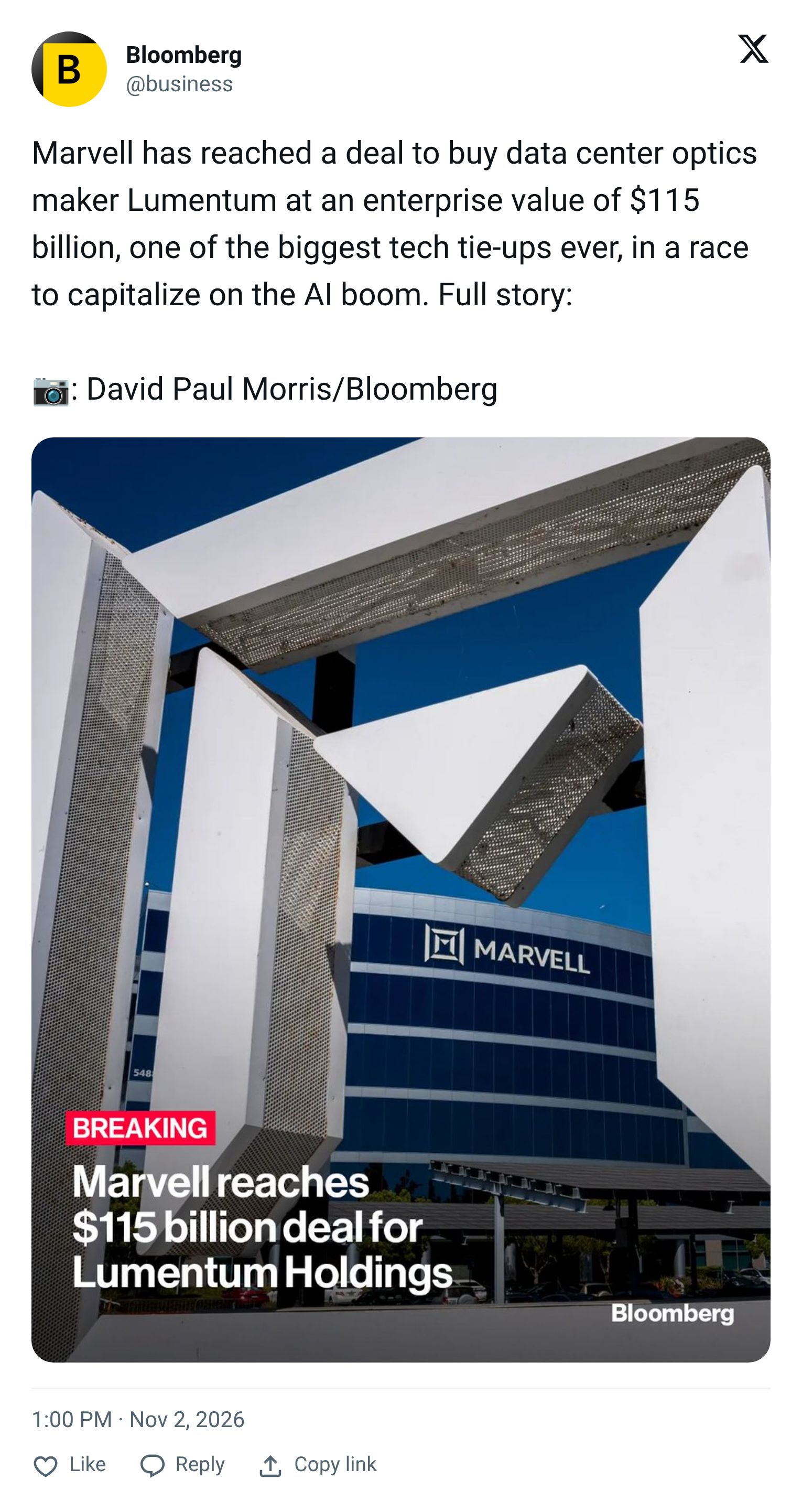
Marvell agreed on 2 November to buy Lumentum for stock. The deal values Lumentum at about $115 billion including debt. Lumentum shareholders get 4.5 Marvell shares each, about $1,132 a share and a 23.9% premium to the price on 28 October. Marvell's shareholders will own about 67% of the combined company. Marvell expects more than $1 billion a year of cost savings and says the deal adds to adjusted earnings per share in its first year. Closing is expected in the first half of 2028, subject to shareholder and regulatory approval. Matt Murphy stays chairman and chief executive, and Lumentum chief executive Michael Hurlston joins Marvell's board with two other Lumentum directors. Marvell puts the combined addressable market at $550 billion and says AI infrastructure is moving toward optical connectivity. It also said preliminary fiscal third-quarter revenue came in at the midpoint of its guidance.
Why this matters:
The $895 billion has to be spent somewhere. Anthropic's commitments are almost all compute and infrastructure, and suppliers are merging to sell more of each cluster.
Paying in stock lets Marvell spend $115 billion without borrowing. Lumentum's holders take a third of the company, and a third of the risk.
The optical link is the part sellers want to own. Marvell's case rests on clusters moving from copper to light, and the deal puts lasers and the chips that drive them under one roof.
Oracle Cancelled a $7bn Lease of Chips to Tencent
About 100,000 chips in Southeast Asia lost their tenant after US officials objected and Beijing told Tencent to buy Chinese.
Oracle has cancelled a five-year deal to lease Tencent about 100,000 advanced AI chips, the Financial Times reported on 4 November. The chips sit in Oracle data centres in Southeast Asia. The deal was worth about $7 billion. US officials raised concerns about it with Oracle, according to the FT. Guangdong provincial officials separately urged Tencent to back Chinese chips, the FT reported. Reuters could not verify the report. Oracle, Tencent and the White House did not respond to requests for comment. The FT first reported the lease in October. NVIDIA has told cloud partners to cap Chinese business at 49% of their capacity, The Next Web reports. Oracle is paying for its cloud build partly with debt and recently priced a $20 billion raise, The Next Web adds.
Why this matters:
The chips now need a new tenant. A five-year lease is how a cloud provider earns back hardware it paid for in advance, and Oracle carries these chips until it finds another customer.
Both governments pulled the same way. Washington objected to Tencent renting the chips offshore, and Guangdong told Tencent to buy Chinese, the same market Meituan trained LongCat-2.5 in.
Offshore rental was a way round both sets of rules. Xingyun's customers in China took rent rises of 79% and 231% (#131), and this cancellation shuts the offshore route for one of China's largest buyers.
Brookfield's Radiant Plans a 1GW AI Campus at Drax Power Station
The first 100MW still needs a tenant, planning approval and a final investment decision.
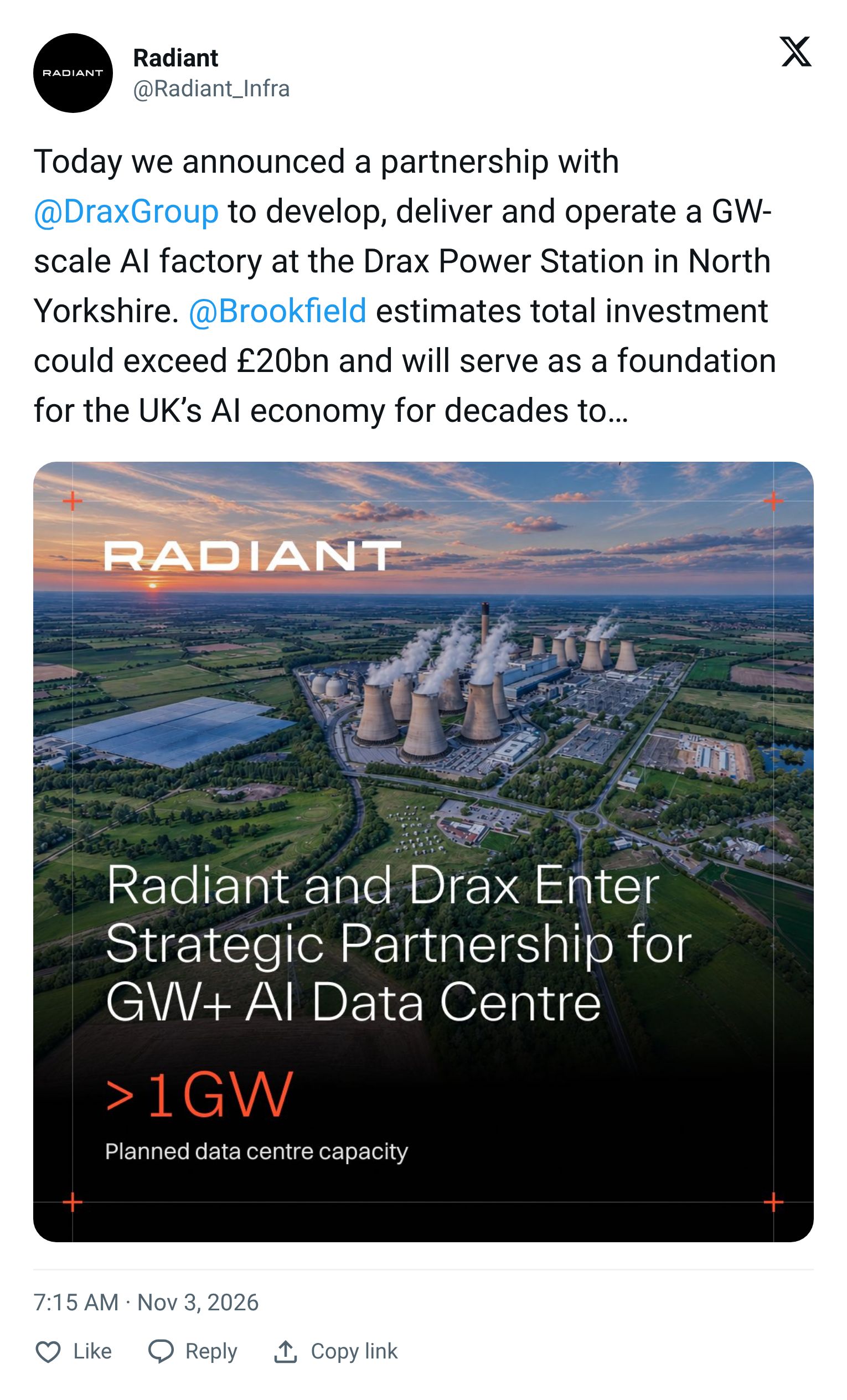
Drax signed a partnership on 3 November with Brookfield and Radiant, Brookfield's UK-headquartered AI infrastructure company, to build more than 1GW of data centre capacity at Drax Power Station in North Yorkshire. Radiant leads design, customers and sales. Drax supplies land, power and planning. Brookfield puts up the money through a joint venture with Qai, which the Qatar Investment Authority owns. Phase one is up to 100MW, running on grid power from early 2028. Brookfield puts its cost at £2.5 billion. Phase two would add 500MW between 2028 and 2031, fed directly by Drax's own generation under a long-term power purchase agreement. Brookfield estimates total investment, including chips, could exceed £20 billion. Before phase one goes ahead, the partners need planning and network approvals, a tenant, signed contracts and a final decision to invest. Drax's subsidy contract pays for about 6TWh a year of biomass power between April 2027 and March 2031. Drax can ask the government to release as much as 500MW of it to a data centre. Radiant was formed in February when Brookfield merged it with London cloud provider Ori, and Reuters put its value at $1.3 billion. Drax shares rose about 8%, and Citi said the deal reads more like a memorandum of understanding than a contract, Investing.com reports.
Why this matters:
Brookfield is both the developer and the money. It owns Radiant and funds the project with Qai. The first outside party will be a tenant, and none has signed.
This is the kind of project that fills Anthropic's contingent column. $213.8 billion of Anthropic's commitments depend on the other side securing financing, facilities or approvals, and Drax phase one needs all three.
The power station needs a buyer after 2031. Drax's subsidy ends in March 2031, phase two is the size of the 500MW carve-out, and JPMorgan reads the deal as a way to keep the plant running.
Everything Else
NVIDIA is weighing a residual value guarantee on Nscale's West Virginia campus, where Anthropic has signed a $44.6 billion contract for the first 460MW building, TechCrunch reports.
DigitalOcean set up a $1 billion at-the-market share programme with eight banks on 2 November.
WhiteFiber paid $60 million for two former North Carolina factory sites, each expected to get at least 30MW of power.
Nebius took a $3.5 billion, 364-day secured facility from Citi at SOFR plus 2.75%, TIKR reports.
Fal raised $1.3 billion at a $16 billion valuation, double its April price, led by Bessemer, TechCrunch reports.
Elon Musk cut Grok's usage limits, citing "unsustainably high" costs, TechCrunch reports.
Five bidders priced China Mobile's 20,480-card AI tender within 0.9% of each other, China AI Dispatch reports.
Moore Threads says its 2,112-GPU cluster in Wuxi reached 92.9% utilisation after going commercial, Pandaily reports.
China's STAR 50 index has lost 47% since June, China AI Dispatch reports.
AEP raised its capital plan to $100 billion, T&D World reports.
PSEG Power plans a 200MW uprate at its Salem nuclear plant as it pursues data centre deals, Utility Dive reports.
Caterpillar posted its highest sales quarter and is expanding engine and turbine production for data centres, Utility Dive reports.
Data centres are turning to old jet engines while they wait for grid power, TechCrunch reports.
Candidates who campaigned against data centres won governor's races in Georgia, Ohio and Texas on 3 November, Heatmap reports.
Lambda plans a $33.1 billion campus in Lowndes County, Alabama, with construction from the first quarter of 2027, and will pay for its own power and grid connection.
Alphabet spent $51.4 billion on capex in the third quarter, and its free cash flow was negative for a second quarter running.
